M119 Tunnel of Trees

Home Page


The M-119 Heritage Route is much more than just a ribbon of asphalt cutting north, taking travelers to and from their destinations.  The splendor of the area results from millions of years of geology, natural and cultural history, and trade.  Proximity to Lake Michigan provides not only scenic vistas, but strongly influenced the location of the roadway.  The roadway crosses hills, gullies, and small valleys, and winds through ancient sand dunes.  The southern part of the route offers spectacular views. 

The so-called “Tunnel of Trees” runs sporadically along the length of the corridor and is comprised of northern hardwoods with beech, maple, and oak predominating among aspen, birch, hemlock, and a few varieties of pine.  The trees are located very close to the roadway, creating the feeling of traveling through a tunnel.  In the fall, the corridor is alive with color.  The diversity of habitat encourages a variety of animal life including whitetail deer, fox, turkey, small game, and various song and game bird species. 


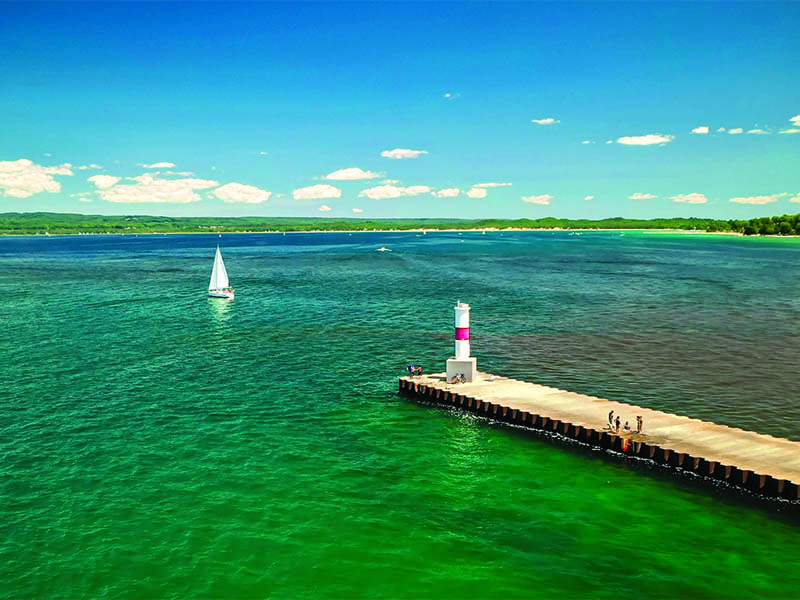
The scenic views along M-119 are among the most stunning outlooks of Lake Michigan in the state.  

Some scenic outlook points are listed below.

Angell Farm: The panoramic views from a 900-foot elevation at this historically significant location provide some of the most spectacular views of Lake Michigan and the Beaver Island archipelago available from M-119. Located in Friendship Township.  This site also goes by the name of Rolling Ridge Farm.

Devil’s Elbow and Horseshoe Curve: Intermittent, short views of Lake Michigan can be seen here.  The forested area here is typical of the canopied “tunnel” the road is known for. Located in Friendship Township.

Middle Village: Located at the intersection of M-119 and Middle Village Road, this site is known in the area for providing an excellent view of Lake Michigan as well as the St. Ignatius Church below the bluff. Located in Readmond Township.

Readmond Township Beach & Edwin F. Hulbert Township Preserve:  The Hulbert Preserve contains 1300 feet of frontage on the roadway.  Although the lake is not visible from the roadway, the Preserve is wooded and contributes to the rural sense of place that defines the corridor near Good Hart.

Good Hart Village:  The unincorporated village has a general store/post office, an antique shop, small log cabin, and a number of homes and cottages.  The area is quaint and historic, offering a destination for travelers and a landmark along the roadway. Located in Readmond Township.


Hemlock Forest & Inland Dune Community: Cross Village Township, near the terminus of M-119, contains some of the densest forest canopy of the corridor.  Within this township, the roadway turns inland and enters a hemlock forest.  Dunes are visible to travelers through mature trees.  The corridor takes on a different character, offering an interior view that is unlike any other along the roadway. 

Historic & Cultural Resources

The M-119 corridor possesses a rich history.  Unfortunately, much of this history is being lost due to a lack of formal preservation initiatives. 

Seven Mile Point: The area below the bluff from Rolling Ridge Farm is known as Seven Mile Point.  It is believed that Native Americans and other explorers used this location as a destination and starting point to traverse the Bay to and from Charlevoix’s Nine Mile Point.  A Native American village, She-na-bah-ma-kong, may also have been located in the vicinity.  Located in Friendship Township.

Middle Village: Aside from its scenic value, this location is known for its history.  Below the bluff at the roadway lies Middle Village, an old settlement dating back hundreds of years.  The St. Ignatius church steeple is visible from the roadway and frames the view.  The church serves as a gathering place and is a community cultural asset as well as a historic feature. 

The story of L’Arbre Croche, or Waganikising as the Odawa called it, is also associated with this site.  L’Arbre Croche was a large, gnarled hemlock used as a location marker by voyagers.  The tree is no longer living; a sign is rumored to have marked the place where it used to stand.  However, now that the tree and the sign have departed, the story of L’Arbre Croche is fading.

Good Hart Village: Good Hart’s formal history is not well documented.  The current Good Hart general store is a replacement of a store that served earlier settlers.  Some cabins settled by Native Americans still stand below the bluff.

Council Tree: The Council Tree is a mature white pine located in close proximity to the roadway in Readmond Township.  Local Native American tribes used this tree as a site to hold council.  Although its precise history is unknown, a sign used to mark its location and explain its significance.  Historic references indicate that a large group of Native Americans gathered at this location in 1787.


Five Mile Creek Schoolhouse: According to local residents, the Five Mile Schoolhouse was owned by the local school district from 1880 until 1960.  By the 1950s the school was no longer utilized for classes and the local community formed the Five Mile Creek Community Association to promote its upkeep.  The building has been maintained and is used by community members for potluck dinners, wedding receptions, and other local events.  The school exemplifies the type of historic preservation projects that communities along the corridor desire.


Hemlock Forest: The size and maturity of this forest make it historically significant.

As was stated earlier in the document, logging was a prominent regional industry.  Further research needs to be done to identify the location of old log sluces, lumber mills, and other related structures that may have historic and cultural significance along the corridor.

Source: www.nwm.org